3. Maths Lines
Lines
I am going to start this tutorial now, but I probably will not have time to finish it. But here goes…
Well, many years later, we may as well actually finish it properly 🙂
The equation of a line can be shown in a few different forms. The two I am going to look at here are the general form and the slope-intercept form.
General form: Ax + By = C
Slope-intercept form: y = mx + c
I find the slope-intercept form easiest to visualise, as it tells you straight out the slope of the line, m, and where the line crosses the Y axis, c.
Finding The Slope
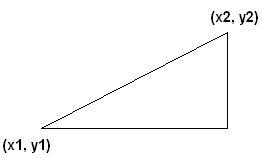
Let us reuse this diagram:

Now first we will look at the slope. The formula for the slope between 2 points is:
m = (y2 – y1) / (x2 – x1)
Simple enough. The one catch is a vertical line, where x2 – x1 = 0. A vertical line has an undefined slope, so you cannot put it into normal slope-intercept form.
Finding The Y Intercept
Now to find c, we use the equation:
y = mx + c
Substitute either one of your known points into the equation. Using point 2:
y2 = m * x2 + c
Then move m * x2 to the other side:
c = y2 – (m * x2)
Now that we have both c and m, we can determine the equation of our line by putting those values back into y = mx + c.
Converting To General Form
Now that we have our formula in slope-intercept form, what about converting that to the general form?
Start with:
y = mx + c
Move the X term to the left:
-mx + y = c
That is already in the form Ax + By = C, with A = -m, B = 1 and C = c. If you want integer coefficients you can multiply the whole equation by a common denominator.
There we go. It only took me a little longer than planned to finish this one…
Questions or corrections? If something doesn’t work or you spot something I’ve got wrong, leave a comment below. These tutorials have been around a long time, so useful corrections are always welcome!


Hey Flekken,
That is true, a line itself has no start or end, it technically goes on forever.
Swiftless
Line doesn’t start or end, only line segment starts and ends in a point.